

When evaluating industrial FDM 3D printing, one question often arises: what actually determines part strength - especially along the Z-axis? The answer is not just materials or fiber reinforcement. It comes down to thermal control, specifically the role of a heated build chamber.
What Does a Heated Chamber Do in FDM 3D Printing?
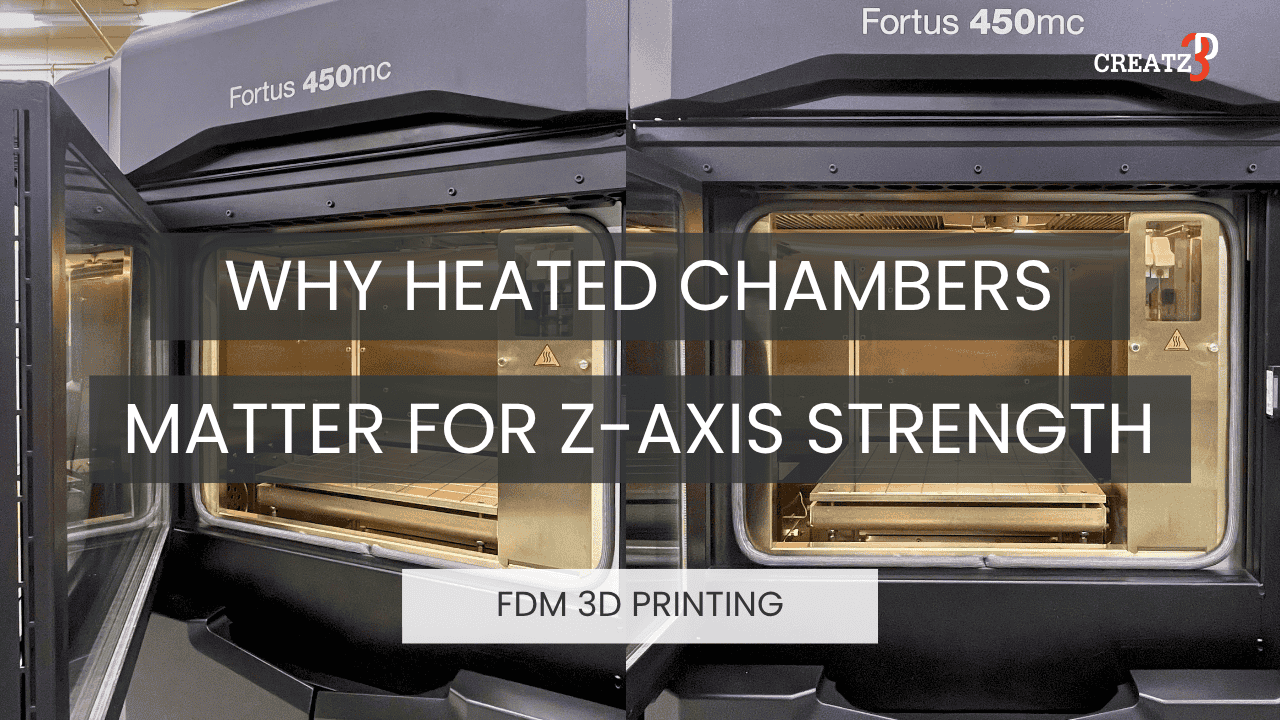
An actively heated chamber, like those used in Stratasys FDM industrial-grade systems, maintains a stable, high-temperature environment throughout the entire print. This controlled heat directly impacts how each printed layer bonds to the next.
Unlike open or passively heated printers, where parts cool rapidly, a heated chamber ensures that previous layers remain close to the material’s glass transition temperature (Tg). This allows polymer chains to properly fuse across layers - resulting in stronger, more reliable Z-axis bonding.
Why Is Z-Axis Strength Important?
Z-axis strength refers to how well layers adhere vertically. Weak bonding can lead to delamination, where layers separate under stress. This is a common failure point in 3D printed parts, especially in functional or load-bearing applications.
A controlled thermal environment improves:
- Interlayer diffusion – stronger bonding between layers
- Reduced internal stress – less risk of cracking or separation
- Consistent mechanical performance – proven reliability in real-world use
How Does Thermal Management Improve Part Quality?
1. Better Layer Adhesion : Keeping layers near Tg allows them to “weld” together more effectively. This creates parts that can withstand higher mechanical loads without failing at layer lines.
2. Improved Dimensional Accuracy : Rapid cooling in open environments causes uneven shrinkage, leading to warping or curling. Heated chambers maintain uniform cooling, ensuring consistent dimensions across every print.
3. Built-In Stress Relief : As parts print, internal stresses naturally build up. A high-temperature chamber acts like real-time annealing, allowing these stresses to relax during the process - reducing the risk of deformation later.
Is Fiber Reinforcement Enough Without Thermal Control?
Fiber-reinforced 3D printing can increase strength in specific directions. However, it does not solve poor layer adhesion caused by unstable temperatures.
Without proper thermal management:
- Layers remain weakly bonded
- Internal stresses accumulate
- Structural reliability becomes unpredictable
In short, continous or chopped fiber cannot compensate for poor thermal stability.
When Is a Heated Chamber Essential?
If your goal is a simple, one-off part, lower-cost solutions may be sufficient. But for:
- Production-grade components
- End-use parts under repeated stress
- Regulated industries such as aerospace, automotive, and defense
Thermal management becomes non-negotiable. It ensures every part performs consistently, not just once but across repeated cycles and real-world conditions.
For industrial additive manufacturing, strength is not just about materials - it is about process control. Heated chambers provide the foundation for reliable Z-axis adhesion, dimensional stability, and long-term performance.
If you are scaling production or working with critical components, the question is no longer whether you need thermal control - but how soon you integrate it into your workflow
Still have questions?
Talk to one of our experts today.