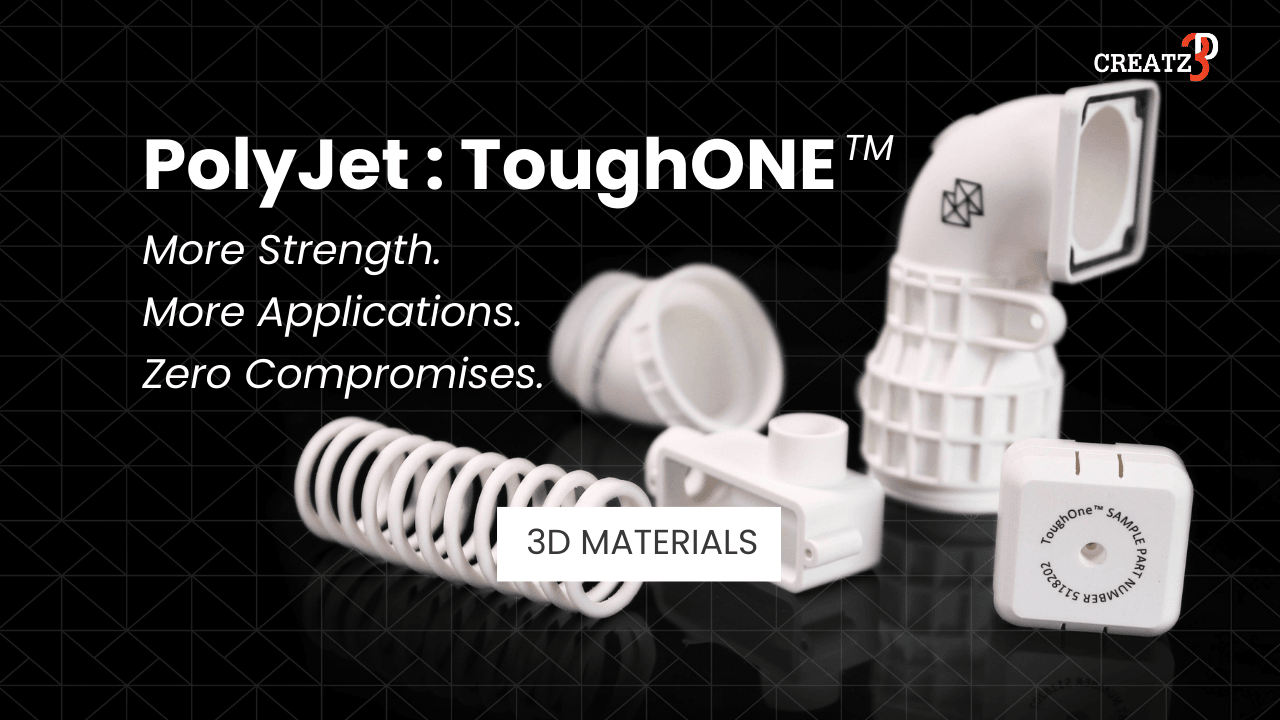


This is where Stratasys ToughONE changes the equation.
For years, PolyJet 3D technology has been synonymous with unmatched surface quality, fine details, and multi-material realism. It has been the gold standard for aesthetic prototypes and design validation. Yet as product cycles accelerate and functional testing moves earlier into development, expectations have evolved. Prototypes are no longer evaluated solely on just appearance - they must with stand real mechanical stress.
ToughONE introduces enhanced impact resistance and mechanical durability to the PolyJet ecosystem. Unlike conventional rigid photopolymers that prioritize form over function, ToughONE enables repeated handling, snap-fit testing, and assembly validation with greater confidence. It empowers engineering teams to conduct more meaningful performance assessments before committing to tooling or mass production.
Fewer redesign loops. Faster iteration. More confident decisions at earlier stages.
What makes ToughONE stronger than standard PolyJet materials?
Introducing a new tier of strength while maintaining PolyJet’s hallmark precision.
- high impact resistance for demanding testing environments
- greater toughness for snap-fits and press-fit assemblies
- excellent dimensional accuracy and surface finish
- reduced fracture risk during evaluation
Which PolyJet 3D Printers are compatible?
ToughONE integrates seamlessly with PolyJet 3D printing machine from Stratasys, including the J55™, J826™ Prime, and J850™ Prime. Organizations already operating J-series platform can adopt immediately, enhancing capability without capital reinvestment or workflow disruption.
Where can ToughONE be applied in product development?
The material is particularly suited for:
- functional prototypes under mechanical stress
- snap-fit housings & assembly testing
- jigs, fixtures and manufacturing aids
- low-volume and end-use components/parts
- consumer product enclosures and industrial parts
Which industries benefit most?
- Automotive teams validating interior trims, dashboard components, housings, and mechanical interfaces.
- Consumer electronics brands refining enclosure durability, handheld devices, and wearables.
- Industrial manufacturers optimizing tooling concepts, functional casings, brackets, jigs and fixtures.
- Design consultancies/agencies delivering high-fidelity prototypes to clients.
How Can You Leverage ToughONE for Competitive Advantage?
Innovation today demands materials that perform, not just impress visually. ToughONE enables organizations to test smarter, iterate faster, and make confident engineering decisions earlier in the development process.
If your development cycle demands prototypes that endure as rigorously as your ideas, it may be time to rethink what PolyJet can deliver. Connect with us to evaluate how this new material can elevate your PolyJet strategy and strengthen your additive manufacturing roadmap.